tetyana.voronova
Case Activity System for Loan Underwriting
The project began with a focused request from underwriters: allow users to pin an important note so it remains visible at the top of a loan file.
Through user research and analysis of real underwriting notes, I discovered that visibility was only part of the problem. Critical findings, decision rationale, unresolved requirements, and next steps were buried inside long, free-form notes.
I reframed the request from a note-management feature into the foundation for a scalable Case Activity system.
Domain
Fintech lending, credit decisioning, underwriting operations
Product
PlatAI Loan Origination System
My contribution
User research, problem framing, workflow analysis, information architecture, interaction design, product strategy
My role
Product Designer and design owner for the initiative

Problem Framing
Initial Request
/ 01
The expected solution was simple: pin a note, keep it at the top, and unpin it when it was no longer relevan. Before designing the interaction, I wanted to understand why underwriters needed certain notes to remain visible.
Before designing the interaction, I wanted to understand why underwriters needed certain notes to remain visible.
What Research Revealed
/ 02
Workflow session with underwriting
The notes were doing much more than documenting comments. Underwriters used them to record:
evidence and documents reviewed;
accepted and excluded income sources;
compliance concerns
required follow-up calls
customer complaints
A single income-verification note could include several reviewed accounts, calculations, the final conclusion, and a request for additional documentation.
The information already existed. The problem was that another person had to read the entire note to understand what mattered.
Research Insight
The problem was not missing information. It was the cost of retrieving, interpreting, and transferring it.
Reframing the Problem
/ 03
Initial question
How might we keep an important note visible at the top?
Reframed question
How might we help everyone working on a loan quickly understand what happened, what was concluded, what remains unresolved, and what should happen next?
This became a case-continuity problem rather than only a pinning problem.
"The information already existed.
The problem was that another person had to read the entire note to understand what mattered."
Reviewed income documentation provided; using the following income to qualify. Used monthly benefit income of $X,XXX/mo. Reviewed prior-year tax documentation for a borrower-owned business and confirmed ownership through third-party sources. Reviewed a federal employment offer for annual income of $XX,XXX and two months of personal bank statements. Total verified monthly income supports the stated income. One additional account was excluded because the tax documentation provided a more representative view of annual business income. Moved forward with the employment offer in lieu of paystubs because the borrower recently started a permanent, full-time position and a paystub was not yet available.
Real Note Example #2
Underwritter
Solution
Structure the Information Underwriters Already Write
/ 01
I introduced a lightweight structure around the full note:
Status
A concise indication of what occurred, such as Requested, Reviewed, Verified, No Response, or Left Voicemail.
Key Finding
The action still required, when applicable.
Next Step
The complete evidence, calculations, and underwriting rationale.
Full Note
The complete evidence, calculations, and underwriting rationale.
We were organizing information they already documented so other people could scan it faster.
Turn Pinned Notes into
Active Issues
/ 02
Research changed the role of pinning.
Pinned notes were not bookmarks or favorites. They represented current concerns that should remain top of mind while the loan was being worked.
designed an Active Issues section that supports:
pinning and unpinning notes;
multiple active issues when necessary;
compact previews for long notes;
access to the complete source note;
clear separation from the historical note list.
This section answers
What currently needs attention on this loan?
Improve Traceability Between Related Notes
/ 03
Follow-up notes often became disconnected from the concern they referenced.
Instead of introducing a complex threaded system, I designed a lightweight reply pattern. A reply includes a visible reference to the original note, and selecting it takes the user directly to the source.
This improves continuity without turning the Notes tab into a conversation or task-management platform.
Old Version

New Version
Suggested Status Note Model
Underwritter

The System-Level Decision
During exploration, I identified a broader architectural risk.
If calls, emails, reminders, next actions, and future agent activity were all added directly to Notes, the Notes tab would eventually become an overloaded operational tool.
I separated two responsibilities.
Notes
/ 01
Historical source of record
complete notes;
evidence and calculations;
decision rationale;
replies and references;
audit history.
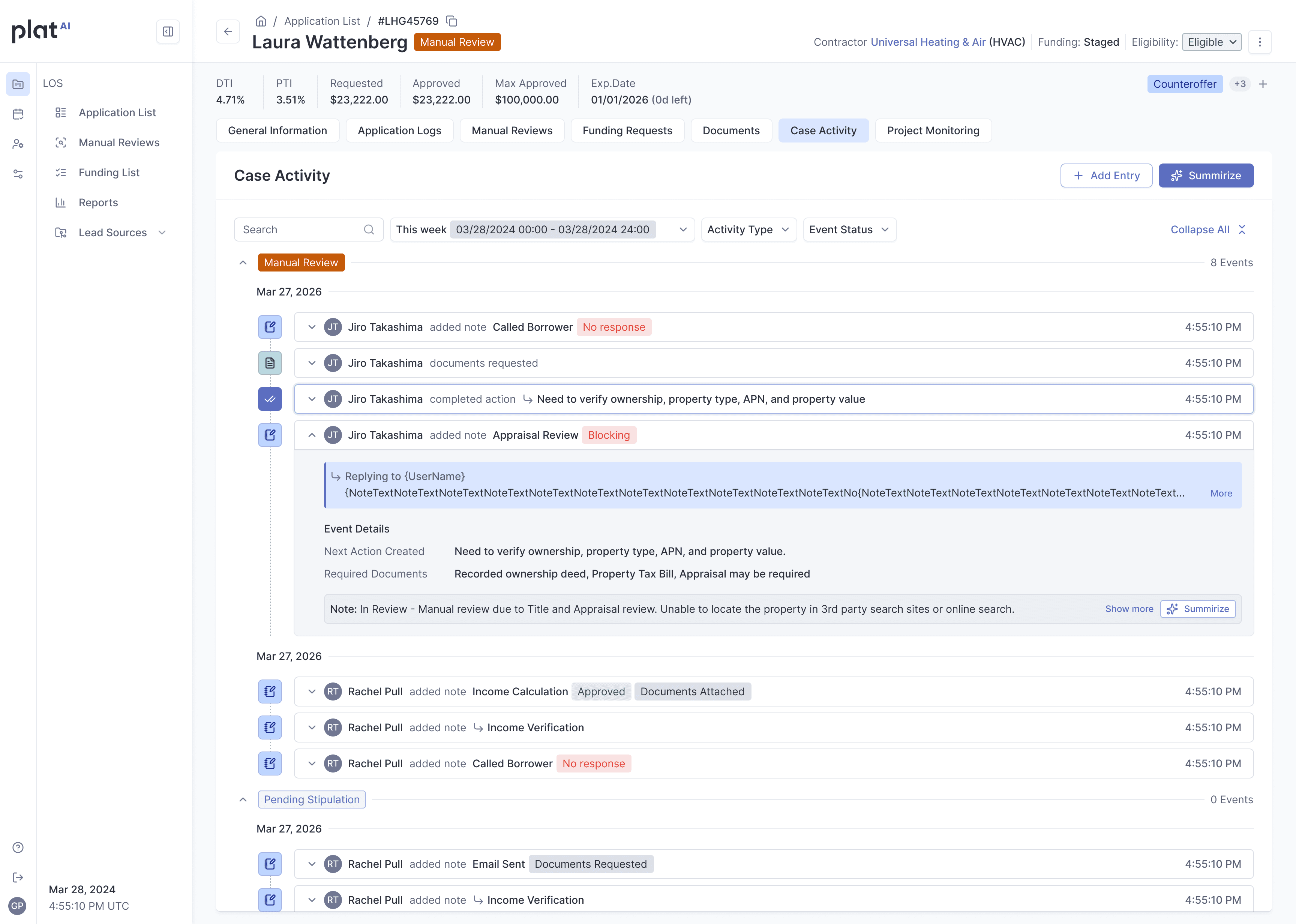
Case Activity
/ 02
Operational understanding of the loan
what happened;
who did it;
when it happened;
what the result was;
what still needs attention;
Notes are the record. Case Activity is the operational view.
For the initial release, Case Activity can be populated primarily from notes. Over time, the same architecture can support calls, emails, document events, automated outreach, and Zoom Agent activity.
This improves continuity without turning the Notes tab into a conversation or task-management platform.
Designing for Responsible AI
The structured activity model also creates a foundation for future AI assistance.
AI could eventually help summarize long notes, extract findings, identify unresolved requirements, or suggest next actions.
I intentionally avoided making AI-generated summaries a dependency for the initial concept. In credit decisioning, generated summaries may omit important exceptions or overstate certainty.
The human-authored note remains the source record. AI should reduce the cost of finding and interpreting information—not replace the evidence or judgment behind a credit decision.
My Contribution
I led the design work from the initial request through research, reframing, and system-level concept development.
analyzed the workflow behind the Pinned Notes request;
participated in research with underwriting stakeholders;
eviewed real underwriting notes to identify recurring patterns;
reframed a feature request as a case-continuity problem;
defined a lightweight structure based on existing user behavior;
designed Active Issues and their use during Manual Review;
improved traceability between related notes;
separated historical records from operational case activity;
defined an incremental concept that could scale to communication channels, automation, and AI;
prepared the proposal for product and engineering evaluation before client presentation.
My primary contribution was not adding a new component. It was identifying the larger business and information architecture problem behind the request.
Expected Value
Because the concept has not yet been implemented, these are intended outcomes rather than measured results:
faster understanding of the current loan state;
less time spent reading and reconstructing previous work;
clearer handoffs between underwriters and operations teams;
reduced context switching during Manual Review;
stronger traceability between findings and source evidence;
a scalable foundation for multi-channel case activity.
Reflection
This project began with a request for a pin icon.
The more important design work happened before the icon: understanding how underwriters document investigations, how case knowledge moves between people, and where the current product architecture created friction.
By separating Notes from Case Activity, I created a model that addresses the immediate workflow while supporting future communication, automation, and AI-assisted underwriting.
The interface is the visible layer.
The larger contribution is the system underneath it.